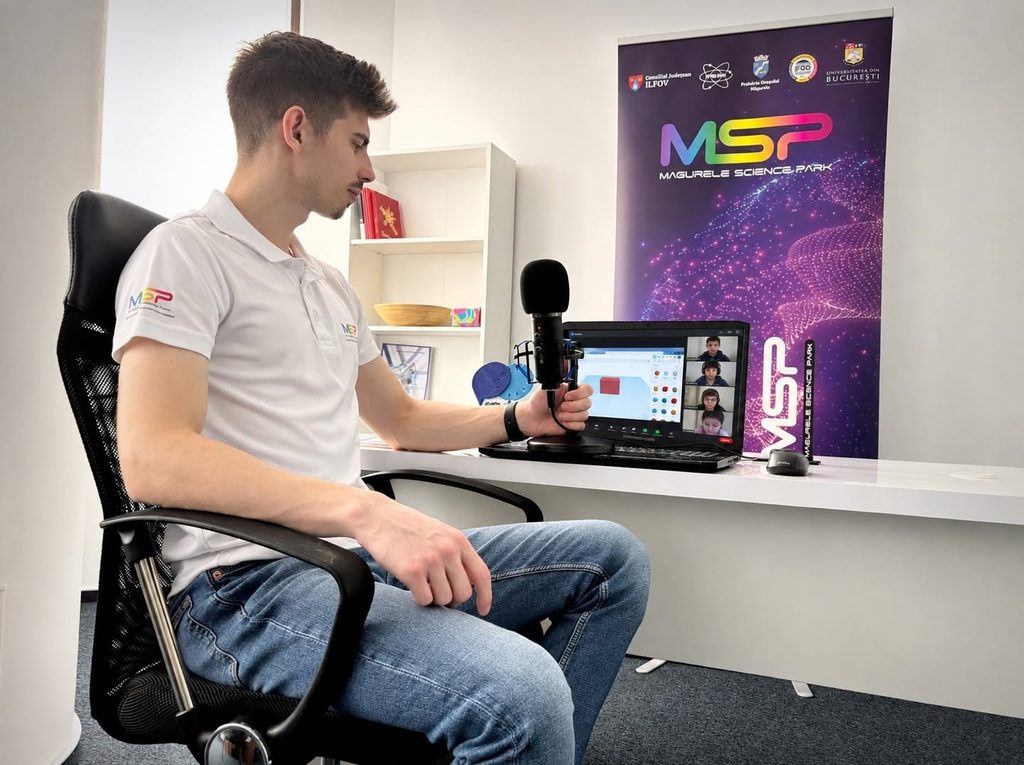
At MSP, we believe that children’s access to science and technology should be a core goal of any modern society, where education is the driving force behind development.
To support this goal, we frequently organize visits to research institutes, giving students the opportunity to get familiar with the work of a researcher through hands-on experiments and presentations that build upon what they learn in school.
At the end of June, we found ourselves alongside middle school students from Politehnica School at the gates of the National Institute for Research and Development in Electrical Engineering – INCDIE ICPE-CA. There, we were warmly welcomed by Mr. Patroi Eros Alexandru, President of the Scientific Council, who guided us behind the scenes of the institute.
Why Does MSP Organize These Events?
We wanted to help students become friends with science — to show them that it’s fun and interesting beyond formulas and calculations. Most importantly, we aimed to challenge their thinking and broaden their horizons by revealing that even subjects requiring greater focus and concentration have their own beauty and purpose.
These subjects can become truly fascinating when students witness real-life experiments and research laboratories with their own eyes.
When Physics Comes Alive: The Story of Energy
The day began with the story of energy. Students explored what energy is through a historical journey — from its earliest form, the Big Bang, and the discovery of fire, to mechanical, thermal, chemical, nuclear, and renewable energy.
They also learned directly from researchers how electricity is generated, the role of generators, and discussed how water energy is converted into electrical energy using turbines and generators. They even had the chance to see a representative installation in action.


The discussion then shifted to chemical energy. Using models and examples, researchers explained this form of energy, stored in the bonds between atoms, and how it can be released through combustion or chemical reactions.
With guided help, students identified that chemical energy is present in bacteria, food, fossil fuels, and biomass.

A day spent by MSP and school students, among test tubes and reactions
Soon after, the young participants were transported behind the curtain of chemistry, where they discovered some of its hidden secrets.
The experiment session included three different chemical reactions, each explained clearly and in terms students could understand:
- The first experiment involved the reaction between potassium iodide, hydrogen peroxide, and food coloring — famously known as the “elephant toothpaste” experiment. It resulted in a colorful, foamy explosion, illustrating the rapid decomposition of hydrogen peroxide.
- The second experiment was an oscillating reaction — a demonstration of cyclic chemical reactions where the color of the solution changes repeatedly, creating a sort of “molecular choreography.”
The final, and perhaps most exciting and popular experiment, was the ammonium dichromate volcano — a spectacular simulation of a “chemical volcano,” where solid substances appear to erupt in jets of orange-green fire, perfectly illustrating exothermic energy transformations.


Introduction to Modern Technologies
The next session focused on contemporary science and how it continues to evolve. Students learned about:
- How sunlight is converted into electricity using photovoltaic panels;
- How bacteria can help us by consuming food waste and generating biogas in the process — mainly composed of methane and hydrogen;
- What biogas is and how it can be used as an alternative energy source.
To wrap up the session, students engaged in a debate in two teams, analyzing the advantages and disadvantages of renewable energy sources such as solar, wind, hydro, and biomass — in terms of efficiency, sustainability, environmental impact, and accessibility.

Magnets, Magnetism, Magnetization
One of the most engaging moments was the discussion about magnetism. The students were amazed to learn how permanent magnets work, what magnetic fields are, and how they influence nearby objects.
They took part in live demonstrations using neodymium magnets, observing attraction and repulsion phenomena, as well as the behavior of iron filings in a magnetic field.
Together with the researchers, they reached a fascinating conclusion: Earth itself is the largest natural magnet we know. Its metallic core generates a global magnetic field that protects us from harmful solar radiation and is responsible for the functioning of compasses, bird migration, and the appearance of polar auroras.
This invisible yet essential magnetic field sparked many spontaneous questions and lively debates among the students.

MSP is looking ahead along with the help of science – a candle in the dark
This event served as a bridge between research and education, between the desire for real-world experience and the excitement of a young generation eager to explore.
We’re grateful to have played a part in expanding students’ horizons and we hope that these seeds of curiosity will blossom into future vocations and passions.
Many thanks to our partners at INCDIE ICPE-CA, Mr. Patroi Eros Alexandru, and his colleagues:
Dr. Eng. Gabriela Cîrciumaru, Dr. Chem. Marius Lungulescu, Dr. Eng. Paula Angheliță, and Dr. Chem. Eng. Gimi Rîmbu.
We look forward to reconnecting soon during future educational events with students.

Authors:
Florentina Ionela Buică (Educational Process Coordinator, MSP)
Patroi Eros Alexandru (President of the Scientific Council and Coordinator of the Alexandru Proca Youth Research Center)