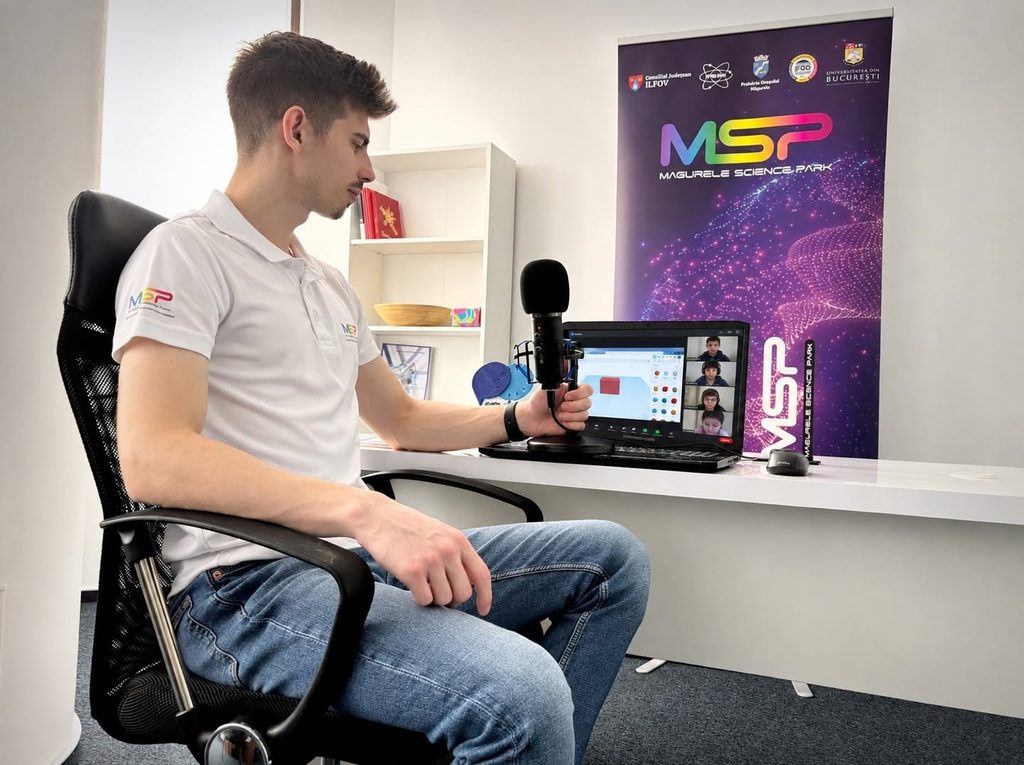
According to information released by the European Commission, more than 72% of Romanians lack basic digital skills, making this one of the greatest challenges facing the country’s digital transformation. Although Romanian schools are equipped with digital tools, developing students’ abilities in analysis, creation, and digital innovation remains a significant challenge.
In this context, our mission becomes even more meaningful, guiding school students toward the shores of knowledge and supporting them in acquiring both digital and scientific competencies.
Through partnerships with national research and development institutes in Bucharest and on the Măgurele Research and Development Platform, we facilitate educational visits for school students eager to learn more about the experiments they study in theory at school and discover how these concepts come to life in real research laboratories.


About the activity
We met with 19 curious school students, accompanied by their IT teacher, in front of the National Institute for Research and Development in Electrical Engineering ICPE-CA. Excited and ready for a new educational adventure, they stepped into the world of research to explore modern laboratories and discover experiments from various scientific fields.
The visit began with an introduction to the history of energy: how it was discovered, its different forms, and how it has contributed to the development of civilization throughout history.
Researchers also discussed alternating current (AC) and direct current (DC), explaining the differences between these two types of electrical current and their main applications in everyday life. Throughout the evolution of modern society, both have played an essential role, driving technological progress and transforming the way we live.
Physics, biology, and chemistry through the eyes of a researcher
The visit continued with a discussion about the profession of a researcher: what their daily work involves, the challenges they face, and how their efforts contribute to societal development.
Students then took part in a series of experiments representing biology, chemistry, and physics.
During the biology activities, they observed flower stigma structures and anatomical features of insects and arachnids under a microscope, discovering details invisible to the naked eye.
The adventure continued with fascinating chemistry experiments that, as always, captured the students’ attention. One of the most appreciated demonstrations showed how certain substances trigger energy exchanges and color transformations, creating a spectacular display until the solution eventually reached a uniform color.
Another experiment that sparked great enthusiasm was the famous “Elephant Toothpaste” reaction. Its basic composition includes hydrogen peroxide, dishwashing liquid, a catalyst (such as potassium iodide), and food coloring. The reaction produces an impressive amount of foam, much to the delight of the participants.
Among the experiments was also a reaction involving water, vitamin C, and potassium permanganate. The purple solution gradually transformed into an almost colorless liquid in a spectacular oxidation-reduction (redox) reaction. The striking visual effect immediately generated numerous questions from the children, eager to understand the scientific principles behind the phenomenon. These moments of genuine curiosity are among the greatest rewards for everyone involved in STEM education.
Creating slime was the highlight of the hands-on activities. School students received containers, materials, and all the necessary substances to create their own slime.
The slime was made from polyvinyl alcohol (PVA), water, borax (sodium tetraborate), and food coloring. Researchers explained how borax forms cross-links between the polyvinyl alcohol chains, transforming the liquid into a viscous and elastic material.


During the physics demonstrations, students observed how magnets interact with different metallic powders and discovered fascinating phenomena involving the interaction between magnets and metals such as copper and iron. The demonstrations highlighted effects such as the slowing of a magnet’s fall on a copper surface and the influence of magnetic fields on metallic particles.
Behind the scenes of a research laboratory
The visit could not end without exploring the laboratory dedicated to photovoltaic cells. Here, participants learned about the main types of photovoltaic panels, how they function, and why the continuous improvement of renewable energy technologies is so important.
They also had the opportunity to see a thermal imaging camera in action and participate in a short practical demonstration. Fascinated, they observed their own thermal images and discovered a completely different perspective on the human body and the surrounding environment.
Looking to the future with enthusiasm
We are delighted to have facilitated this educational experience and to have brought school students closer to the world of scientific research.
The MSP team is always ready to organize not only educational activities but also memorable experiences that transform learning into a true adventure. We hope these encounters inspire curiosity, a spirit of exploration, and a desire to contribute to the advancement of science and education in the future.

Perhaps among these students are the future researchers, engineers, and teachers who, years from now, will inspire new generations of children to discover the beauty of knowledge.